By Immanuel Ben Misagga
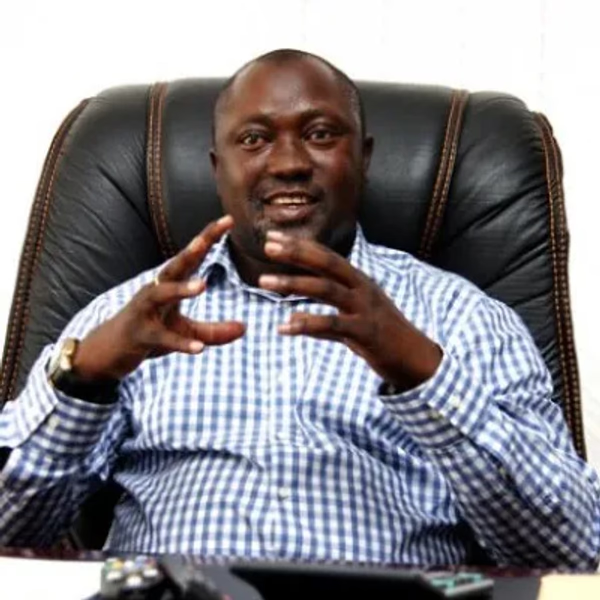
SC Villa President Emeritus
Summary
Dear all, this is an account of my Villa career, which dates back to the 1990s. I have been in and out of the club leadership, but if there is one constant I have noticed, it is the greed of owning the club by a few individuals.
In this document, I narrate my endurance, success, intrigue and the way forward for the club to return to the good old days.
Background
Back in 2001, when the late Ogen Kevin Aliro nominated me to become the SC Villa national coordinator, the club administration and management unanimously approved me.
A few months into my work, however, several prominent officials grudgingly started fighting me because of my popularity among fans. They thought that, through my mass mobilisation, I was wielding power akin to that of the club president, Franco Mugabe.
Ahead of the 2004 Cecafa Club Championship in Mwanza, Mugabe, along with then club secretary Edward Luyimbazi Mugalu, admitted the club was financially strained and could not travel to Mwanza, Tanzania, for the tournament. They advised me that if I could mobilise funds, then I could take the team to the tournament.
Thanks to well-wishers such as Capt. Mike Mukula, Maj Gen James Kazini, Col Poteli Kivuna and Chris Mubiru, among others, we raised funds and took the team to Mwanza. Denis Obua, then FUFA president and CECAFA chairman, offered us free fuel for the tournament.
Still, some senior players refused to travel, citing the likely nonpayment of their allowances. That is how I ended up convincing a young Villa squad, which included Dennis Onyango, who was the third-choice goalkeeper, to join me.
On the way, I was notified about the availability of Bernard Mwalala, a Kenyan striker. Given how low morale at the club was, I dipped into my wallet and bought him from Gor Mahia for Shs 12m just in time for the tournament.
This started a fairytale run that not only had Villa winning the tournament, but also saw Mwalala emerge as top scorer while the hitherto unknown Onyango did not concede a single goal.
For the triumph, President Kagame gave us prize money of $30,000, which I received and brought back home and gave to Luyimbazi, who had handed me the team. Meanwhile, President Museveni chartered us a plane back home and hosted us to a state dinner on top of gifting us a bus. Incidentally, the club is still using the bus to this day.
This was the start of the Villa renaissance, especially after the disastrous 2003 match-fixing scandal in Ugandan football that chased away many fans, especially corporate ones.
In 2005, I offered myself to become the club president.
Just two days before the club general elections, the club’s top hierarchy invited me to a meeting at Kampala Serena Hotel. In attendance were Mugabe; Omar Ahmed Mandela [Treasurer]; Guy Kawuma; Andrew Patrick Luwandagga; Topher Musoke; and Luyimbazi, among others. They offered to hand over the team to me if I were willing to take up the mantle and handle the financial burden.
Come D-day, my only opponent, Kawuma, kept his word and stood down for me and offered to back me up. But just before I could be announced unopposed, a group of rowdy people stormed the meeting, and it was aborted. Later, I discovered that Mandela was their sponsor.
Amid the confusion, Balamaze Lwanga, the patron, handed back the reins of the club to Mugabe and Mandela. I later learnt that it was a deceitful manoeuvre by Mugabe and Mandela to continue leading the club despite all signs showing they had lost popularity. They knew they stood no chance if they had offered themselves for re-election. For context, Mandela had already been chased by fans at Namboole Stadium in April 2004.
This setback delayed the club’s progress by several years.
Several club leaders advised me to seek court redress, but in the interest of the club, I simply took a back seat to concentrate on my construction work projects in Zambia.
Enter Muwema
In 2010, after fully draining the club, Mugabe and Mandela handed it over to Fred Muwema as club chairman.
In 2012, the club got divided into two, with the Muwema-led Villa, supported by Mugabe and Mandela, playing another league while the fans-led Villa—orchestrated by Moses Magogo and led by Salim Semmanda with Moses Matovu as treasurer—played in the FUFA-organised league. Kawuma and Musoke also sided with Semmanda.
By 2013, Muwema had abandoned his Villa while the fans-led Villa in the FUFA league was surviving on handouts from well-wishers.
By 2014, Villa was on the brink of collapse. That is when FUFA President Lawrence Mulindwa and Charles Bakkabulindi, then State Minister for Sports, visited me in Ndola, Zambia, and pleaded with me to return home and rescue Villa.
Semmanda and his team, which included Musoke, Ibrahim Kirya, Dennis Mbidde, and Musa Muteebwa, approached me upon my return home. They informed me the club was on the brink of being evicted from Villa Park in Nsambya due to non-payment of the lease, which had accrued over six years.
They asked for my financial help to buy, among other things, new players as well as cover other operational costs. I offered my help in the form of a friendly, reimbursable loan to the club of Shs 300 million. Because the club didn’t have any collateral, my company, Lusaka Commodities, which was lending them, was offered the opportunity to acquire shares in the club until the loan had been paid back.
Present on July 22, 2014, when I gave them the money were Semmanda, Musoke, Kirya and Muteebwa. Meddie Nsereko, Moses Musasizi and John Bosco Kasasira represented me.
Later that year, Semmanda and his Villa leadership offered to support me at the club presidency polls, reaffirming the efforts of Mulindwa and Bakkabulindi.
The FUFA-supervised election, presided over by Kikadde Tazenya, had me elected unopposed after paying the nomination fee of Shs 10 million.
I found the club in total disarray, without structures as a corporate entity.
Olive Branch
Immediately, I reached out with an olive branch to Mugabe and Mandela to join hands as patron and trustee chairman, respectively. To my surprise, both told me off, claiming they were still loyal to the defunct Muwema-led Villa and, therefore, could not join my leadership.
One of the things I did was to clear, four years in advance, the lease payments at Villa Park.
In the meantime, I briefly shifted our home ground to Mityana to test fan enthusiasm and try to reignite the fanbase there, which had welcomed a maize project I took there in my capacity as club coordinator.
Mobilisation Drive
In just a few months, fans’ enthusiasm had returned to Villa. We narrowly missed out on the league title after finishing runners-up to Vipers. It was an uplifting achievement because we had not been in the top five for many years.
That very 2014–2015 season, we won the Uganda Cup after toppling KCCA. This was the club’s first silverware since 2003.
We opened up branches countrywide in Central, Eastern, Western, West Nile and the north. Within a year, the registered fan base had grown to more than 20,000 and was administered through branches, including schools such as St. Henry’s College Kitovu, St. Mary’s College Kisubi, Namilyango College and Kibuli SS, among others.
What’s more, I realised that Villa needed some celebrity boost—people who could inspire fans. Many top singers such as King Saha, Irene Ntale, Rema Namakula, Winnie Nwagi and Mathias Walukagga, among others, became club ambassadors, and their Villa-themed songs continue to be club anthems.
In many of the mobilisation drives we made across the country, my goal was to create a club with a national identity. I always made it a point to establish a lifetime bond with the communities.
For instance, when we went to Masaka, I picked Nicholas Kasozi. I signed Ambrose Kirya during our eastern tour. Then I landed on Vitalis Tabu after he excelled against us for Paidha Black Angels.
And, by the way, it was on this tour that I spotted Sarah Adong and catapulted her to become a Villa spokesperson.
Return to Glory Days
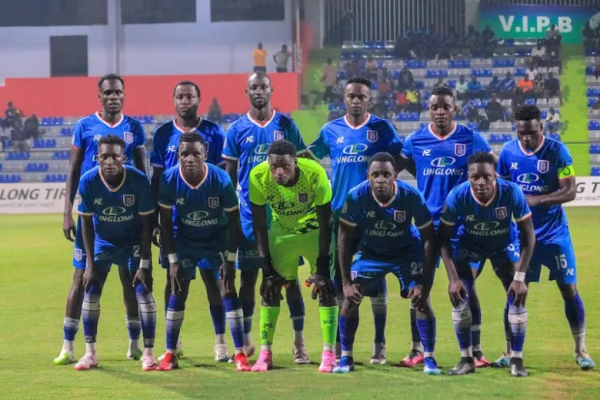
By 2016, the Villa ascendancy was in overdrive. Our continental journey in the Caf Confederation Cup was nothing short of a fairytale.
Midway through the tournament, I got a call from Pastor Robert Kayanja, who was concerned that I was carrying so much weight for the club given that continental football is very expensive.
He offered to bring back Mandela and Mugabe and organised a meeting at Mandela’s Café Javas in Kamwokya to forge a way of boosting the team’s financial muscle.
To our surprise, Mugabe and Mandela did not turn up but instead sent William Nkemba, who offered us $2,000 of the Shs 160m budget the club had for the away game against FUS Rabat in Morocco. For his part, Ps Kayanja gave us $10,000.
What disappointed me about this meeting was the impression that Mandela and Mugabe believed I was struggling under the burden of the club and therefore required their financial assistance.
Yet there were pertinent issues to engage them on, such as the fate of Villa Park and the unregistered club land in Lukuli, which was under threat. I get satisfaction from the fact that I sorted out Villa Park issues and secured the land title for the Lukuli land, which I handed over to the club founding members.
Around this time, Uganda Railways management informed us of our pending eviction from Villa Park, and we commenced talks on compensation if we were to leave.
Back to the football: when President Museveni learned that our fairytale run on the continent was raising the Ugandan flag high, he called me and offered us Shs 400m.
Despite Villa’s eventual elimination, they remarkably won five out of the six games in the competition.
That very year, celebrations of Villa’s 40 years transformed everything. Ahead of the big day, I took it upon myself to send out invitations to every known former Villa administrator and player, even President Kagame. Mugabe and Mandela yet again did not turn up.
I am glad President Museveni honoured the colourful event and even went ahead to gift a brand-new bus and a milling plant—after learning about our project in Mityana—to help the club generate income for sustenance.
By now, Villa’s potential was boundless. StarTimes, seeing how Villa was standing out from other clubs, approached and offered us a sponsorship package of Shs 140 million per season for two years.
For context, Villa was also leading the UPL table, and we were just about six months from the club elections.
Threats Emerge
But in the midst of the big dreams I had for the club, I did not envisage that I was “stealing the show” and that some elements of Villa’s founders and former leaders were plotting to take over the stage behind the scenes.
Of course, I had heard those rumours, but I thought no sane person could plot to kill something and then inherit it.
The next course of events happened shortly after my executive had shared with FUFA, the regulator, a roadmap for elections.
All of a sudden, the club branches that used to feed the team and financially contribute whenever it travelled within their areas, such as Mbarara and Jinja, were ordered by some elements of former administrators to stop because “President Museveni was already financing the club.”
Then, as we edged closer to our first league title in 14 years, I heard that some players were being approached to throw away matches. I noticed a certain pattern in the team’s play.
While I attempted to conceal the players, media outlets fabricated stories to cast doubt on the club’s legitimacy. In fact, when I checked with the Uganda Registrations Services Bureau (URSB), it emerged that there were 12 other registered Villas. The aim was to confuse sponsors.
Then boom. We lost Villa’s would-be league-winning game against Vipers, and the team never recovered. All players were coerced not to renew contracts with the club.
One day, I woke up to a clique of purported fans who had stolen office equipment at the newly refurbished Villa Park club office.
Something was getting very fishy.
The strange thing is that these threats were not coming from rival clubs but from within.
The final straw was when the said clique, backed by former administrators, used the cover of a petition to FUFA claiming that Lusaka Commodities had taken over Villa.
Unfortunately, FUFA was a willing buyer of that information and went ahead to print it in the press in order to raise public anger. That is when I knew I had to make a decision.
I asked myself, “Nfaaki?”
The Decision
I saw the club on the verge of implosion and invoked King Solomon’s famous decision in a baby dispute.
I called a fans’ general meeting and announced that I would not seek to renew my term as club president and that I would hand over all club assets and liabilities to FUFA.
After four years of dodging me, I received a call from Mandela pleading with me not to hand over any assets to FUFA. What he was after? Your guess is as good as mine.
Anyway, I handed every club asset to the federation with audited books of account without a single debt or arrear.
I will leave it to you to determine what happened to the club’s support after that.
The Aftermath
Weeks later, Mandela, Mugabe and Nkemba took over the club’s running.
Their first task was to change the club crest, perhaps in an attempt to erase my legacy and that of Patrick Kawooya, the club’s first president who came up with the logo along with Luyimbazi.
Then they disengaged the club from fans by taking it from Villa Park to East High, a tactical move clearly intended to avoid any confrontation with the community fanbase, which forms the backbone of my support.
Lest I forget, my former vice president Muhammad Bazirengedde successfully litigated the compensation for Villa, and judgment was delivered in his favour about four years ago, helping Villa secure at least Shs 3.4 billion.
Unfortunately, the Villa executive hijacked the money, and it was at that point the club board of trustees was instituted with Gerald Sendaula as chairman. This was merely a vehicle to legalise the acquisition of the money.
To this day, no one outside the inner circle knows the fate of that money, although it is claimed it was put on a fixed deposit account.
But all that is talk—nothing to show for it.
Yesterday, the club administration declared Mandela the sole candidate for the presidency, but the process is so farcical because the end goal is to preserve the status quo.
You have already heard about the Shs 100 million nomination fee for the club presidency.
If President Museveni can allow people to get nominated for just Shs 20 million and stand against him, how can a Villa election be that restrictive?
Not that I cannot afford it, but at the moment my biggest focus is fighting to have the club reinstate the statutes ratified by FUFA to maintain, or reintroduce, a corporate governance structure where a fan of any background or education can have their say in the running of the club.
We should get away from this business of “big-man syndrome.”
For instance, why claim to keep the club funds in an account when those funds can be used to create a SACCO that can change the lives of fans and communities?
Take the example of lending that Shs 3.4 billion: creating a Villa SACCO would attract thousands. Not only would it empower them, it would also create the foundation of a solid fan base for the club.
So, in simple terms, Mandela is just a charitable capitalist and impact investor at Villa—someone who gives but gains more from the product or service.