THE MOUNTAIN MOROTO: THE LAND OF THE WARRIORS
My sons, my daughters, sit down. Don't see me enjoying my life now and think it is because of your dealing with me now that I have made my way. No! Tewewana mbu gwe onyambye. Nekolede. I have seen it all. I have gone through fire to be what I am. Mpise mu tanuulu. I have passed through the fire!
Listen to this one. This is not a story from a book. This is not Ngugi or Shakespeare. This is my own life. My own blood. My own sweat.
Well, this was 1996, after the election. M7 had just won. The country was still breathing. My company was doing serious work in Karamoja, specifically in Moroto, South and North.
Ahhh, Karamoja in those days! Karamoja was not for jokers. Karamoja was not for soft men. Karamoja was the land of warriors! Real warriors!
I am talking about the Bokora — tall, fearless, with spears like trees. The Matheniko — proud, stubborn; they don't blink. The Jie — silent killers; they move like the wind. The Pokot — they cross borders like they own the earth. The Tepeth — the owners of the mountain, the keepers of the gods, the first people of Moroto.
These are men who were born with a spear in their hands and a knife on their waists. Men who walk barefoot on stones that would cut your shoes. Men who drink blood and milk and call it breakfast. Women who carry babies on their backs and water on their heads and still walk like queens.
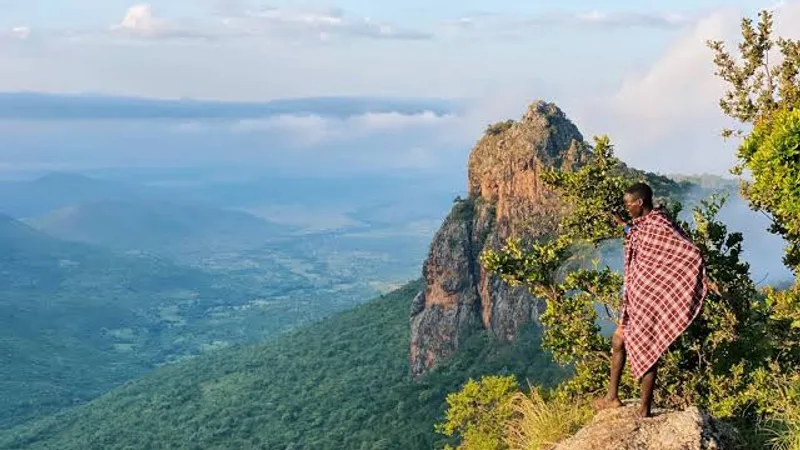
Mount Moroto is not just a mountain, my sons. Mount Moroto is a warrior. It stands there, big, black, silent, watching you. It has rocks like teeth. It has cliffs like a trap. It has a voice that only the Tepeth can hear.
The road from Soroti to Moroto, 189 kilometres, would take you 8 hours! 8 hours! Dust, stones, potholes like graves, rivers with no bridges, heat that burns your skin like charcoal. You would leave Soroti in the morning and reach Moroto when the sun had already gone to sleep. You would arrive with your shirt white with dust, your throat dry like a desert, your bones shaking like a leaf.
And I was driving a Nissan Sahara. NEW! Shining! Powerful! In those days, we were very few with it. When I passed, people would turn and say, "Waaa, whose son is that?" The Sahara was like a lion on the road. But in Moroto, even a lion must bow to the mountain.
The Bishop of Moroto then was His Eminence Bishop Kalanda. A big man. A holy man. A man with a heart for his people.
He saw how I had sorted out the rough sections of the road in the Iriri and Nadunget areas. Seriously, this is one of M7's master roads. I had made the impossible possible. I had made the stones flat. I had made the mud hard. The Bishop watched me, and he said, "My son, you are a man who can work."
One day, as the Bishop passed, he stopped me. He spoke to me about the water problem at Moroto Monk, at the base of Mount Moroto. The monks were suffering. The people were suffering. Women were walking kilometres for dirty water. Children were drinking from the same hole as cows. The warriors were thirsty. The mountain had water, but the people had no water.
He wanted me to do the project for him, from design to implementation. A turnkey project. Everything. I design it, I build it, I hand over the key when the water is flowing.
The film movie I didn't write the script for started.
I signed the contract happily. I was young. I was strong. I was a Catholic, a man of Ekerezia. I thought, "This is simple. I will go up the mountain, find the source, bring the water down. Finished!"
Whoooo! The movie started!
My Nissan Sahara failed to climb the mountain to reach the source of the water, midway up the mountain. I tried once. It failed. I tried twice. It failed. I tried several times. It failed! The mountain refused my Sahara like a woman refuses a man she doesn't love — Yintana. The wheels were spinning, the engine was crying, the stones were falling, but the mountain said, "No!"
Then, from nowhere — I mean, from NOWHERE — a group of Tepeth people, fairly old people and youth, appeared and stopped me and my crew to ask us where we were going.
They came out of the rocks like spirits. Old men with beards white like cotton. Youth with eyes sharp like eagles. They stood in the road like warriors guarding their king, with very beautiful young girls standing behind them, watching, curious, strong like their mothers.
We explained. We were polite. We said we were coming to bring water. Adkinyi understood and explained to the village. She was a young girl in her 16th year; she knew some basic English. She was the bridge between us and the village. She stood there bravely and translated: "They have come for water. They have come to help." Without her, we were deaf and dumb on that mountain.
They looked at me, straight in the eyes, and told me, "You cannot go there until they initiate you and you appease the Tepeth gods. That's when we can work in the area."
Me? Initiate me? Appease gods? I am a Catholic! A man of Ekerezia! I refused to listen. I said, "No, no, no! My God is enough!" I turned my Sahara around and went back to Kampala.
In Kampala, I bought a blue Suzuki, small, strong, a mountain climber. I said, "This one will climb. This one is light. This one will not fail."
I came back to Moroto. The Suzuki tried. It tried hard. It climbed, climbed, climbed, but it failed just near the source. We got stuck at the cliff! The car was hanging, the stones were falling, my heart was beating like a drum. We were stuck between heaven and the grave. The mountain was laughing at my Suzuki. The warriors were watching from the rocks.
And from nowhere again, the more elderly people, mainly women, came and told me to first please the Tepeth gods before anything could be done. They were not joking. Their faces were serious like thunder. These were mothers of warriors. Women who had buried sons. Women who knew the mountain more than any engineer.
They ordered me to bring a male donkey that had not yet mounted, milk, and a she-goat.
I brought them. What could I do? The mountain had defeated my machines. My education had failed. My money had failed. My Catholic pride had failed. The warrior mountain had won.
That day, over 100 villagers gathered. Everyone with a knife. Everyone. Old men, young men, women, children — everyone with a knife shining in the sun. It was like a band. The knives were clapping. The people were singing. The mountain was listening.
The chief priest came with Ndekku, the traditional pot, the sacred thing.
Then the ritual started.
The donkey was pierced — not slaughtered. Pierced. Blood oozed out like the River Nile! Red, hot, flowing. The stomach was cut, and dung was taken out. This was mixed together — blood and dung — and our bodies were smeared. My face, my chest, my hands — smeared! I was no longer a Catholic engineer from Kampala. I was a son of the mountain. I was a son of the warriors.
The balance was mixed with the goat's blood and given to us to drink raw. Raw! This was a testing moment of my youthful experience. My stomach turned. My heart said, "Run!" My head said, "This is too much!" But my spirit said, "If you want water, drink."
I drank. And everyone clapped with the knives. Clap, clap, clap — like a band, like a war dance. I had passed the test. The warriors nodded. The old women smiled. The mountain opened its eyes.
Then the meat was roasted with the skin, half-cooked, and we were served. I couldn't eat because I didn't have the small knife to cut small pieces. The guys enjoyed it until the bones were white like snow. White like snow in Russia! They ate until nothing remained but clean bones. Warriors eat like warriors; they don't waste. They eat until the bone is clean.
One rib bone was pierced with a hole and put around my neck with a rope made from the skin of the donkey's tail. I was supposed to wear this until the project was done. I was not supposed to explain to anyone outside the gathering why I was wearing the bone necklace.
Ahhh, my sons! That was the hardest part!
When I reached home, my wife asked me about it. "What is this? What is this bone on your neck? Where have you been? What have you done?" And I couldn't explain. My mouth was sealed by the oath. My heart was bleeding.
She had to run away from home, calling me omulogo, a witch! A witchdoctor! Imagine! Your own wife running away because she thinks you have become a witch. It was a trying moment. I slept alone that night, with the bone on my neck, smelling of blood and smoke, crying inside like a child.
But I did not remove the bone. I kept it. I kept my word. A warrior does not break his oath.
And from that day, the mountain opened. The source opened. The water opened.
I executed the project very well. Completed! Water flowed from the mountain down to Moroto Monk. Clean water! Sweet water! The monks drank. The people drank. The Bishop smiled. I thought the war was over.
But no! Now comes the fight when the pipes reached the downslope!
The Bokora, Matheniko, Jie, Pokot and Tepeth started a fight, each claiming the water was theirs! "This is our water!" "No, this is our water!" "We are the owners of the mountain!" "We are the owners of the land!" These are warriors, my sons. When warriors fight for water, it is not a joke. It is blood. It is spears. It is fire.
All the HDPE pipes were cut into pieces! Cut, cut, cut! Like they were cutting a snake. My work was destroyed in one night by jealousy and tribal rivalry.
Until the Catholic Church and the NRA settled the fight and cooled things down. The Church prayed. The soldiers stood. The elders talked. Slowly, slowly, the anger cooled like hot porridge.
We were paid twice because of the spoilt work. Yes! God turned my loss into double payment. What the enemy cut, God made me earn twice.
And what fascinated me most — listen to this, because this is the part history has hidden — was that when I went for payment from the CAO, the Chief Administrative Officer, I looked up at the building. I was walking to collect my money, my shoes dusty, my shirt sweating. And there, on the stone on the building, written in cold, hard letters, it said: THIS BUILDING WAS BUILT WITH MONEY FROM THE KABAKA OF BUGANDA, SSEKABAKA FREDERICK LUWANGULA MUTESA, THE KABAKA OF BUGANDA.
Banange! I stopped. I froze. I read it again. And again.
The Kabaka! Our Kabaka! The King of Buganda had built the headquarters of Moroto! In Karamoja! With Buganda money! With a Buganda heart!
But no one writes about it. No one talks about it. Not even the Karamoja leadership speaks about it. Not in school. Not in newspapers. Not in Parliament. Not on radio. Silence! Total silence!
Why? Why do we hide our own history? Why does Buganda give and Karamoja forget? Why does the stone speak but the people are silent?
I stood there, my sons, with my bone necklace still fresh in my memory, and I understood: This Uganda is one. Long before politics, long before tribes fighting over water, a Kabaka from Buganda built for warriors in Moroto. A king from the south built for the northeast. That is the real Uganda. That is the real brotherhood.
But we have buried it. We have buried it like we buried my pipes. We cut the truth into pieces like we cut the HDPE.
That stone is still there, my sons. Go to Moroto and read it. The stone does not lie. Men lie. Leaders lie. But the stone — the stone remembers the Kabaka.
That day, I collected my payment with tears in my eyes. I had come for money, but I left with history.
But that night of handover, another movie started. My machine operator was nearly killed by the Matheniko boys because he had impregnated their sister! Ahhh! Love in Karamoja is not a joke! In the land of warriors, if you touch a sister, you touch the whole clan! The boys came with spears, with anger, with knives. They wanted blood. My grader tyres were cut into pieces!
I had to drive him at night to hide him in Namalu with the girl. Night drive! Dark! Dangerous! Karamoja at night is not for cowards. I drove them, hiding, praying, sweating, until they were safe. I was driving like a warrior, not like an engineer.
And today, listen, they are still married, even now, in Kyanamukaka! That girl, that boy, that night of fear became a marriage! They have children. They have a home. That is life! Love that started with a spear became a family that still stands today.
So, my sons, when you see me today, don't think I just woke up and became the Oracle. Don't think money gave me the way. Don't think your dealing with me now has made me.
I have gone through fire to be what I am. I have drunk raw blood. I have worn a bone on my neck. I have been called omulogo by my own wife. I have been defeated by a mountain. I have seen pipes cut. I have seen tribes fight over water. I have driven a man at night to save his life from love. I have stood in the land of the warriors, and I did not run. I have read the stone of the Kabaka that everyone has forgotten.
Tewewana mbu gwe onyambye. Nekolede.
Money is a good devil, yes. But a man is made by the fire he has passed through, not by the money he has counted. A warrior is not made in Kampala but in Kifuuta. A warrior is made in Moroto and Kifuuta Katooke, on the mountain, where the mountain refuses your car and the gods demand your blood.
If you are going through fire now in your marriage, in your business, in your work, in Karamoja or in Kifuuta, don't run. Drink your bitter cup. Wear your bone. Keep your oath. Finish your project. Water will flow.
The Kifuuta Oracle has spoken. I have seen it all.